
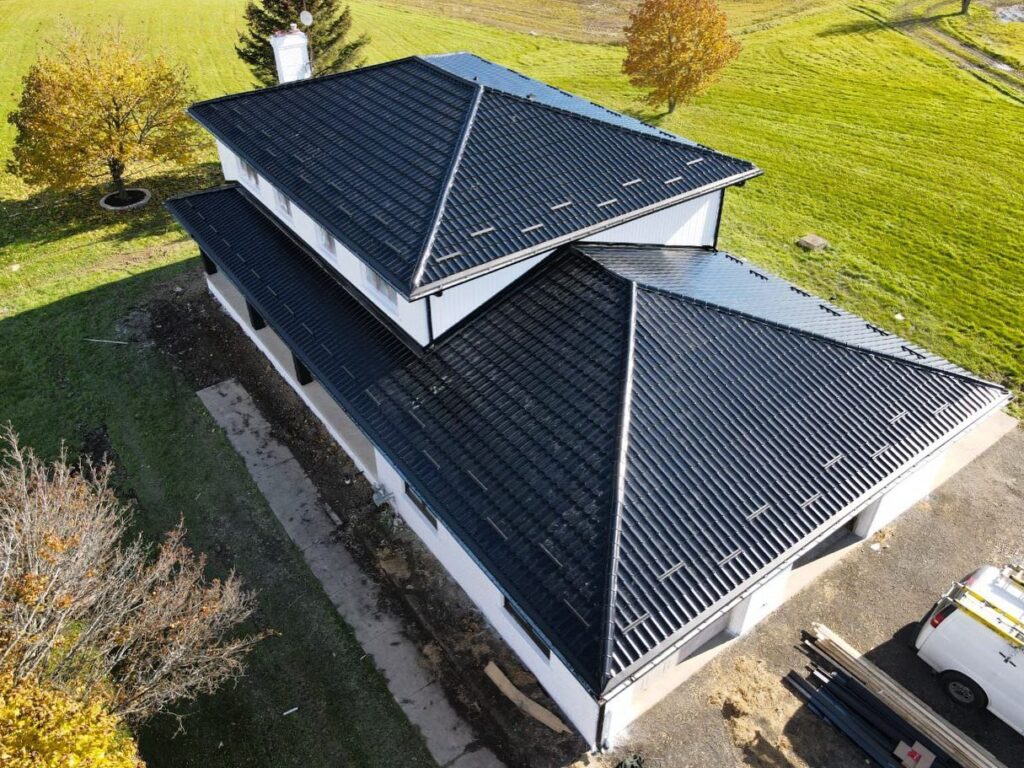
When Ontario homeowners choose metal roofing, one of the first decisions they face is which type of metal roofing to install—metal tiles or standing seam. Both are excellent products that will last 50+ years in Ontario’s climate, but they are quite different in appearance, cost, performance, and suitability for different home types. This complete guide helps GTA homeowners make the right choice for their specific home.
What Are Metal Tiles?
Metal tiles are steel panels manufactured to resemble traditional roofing profiles—most commonly a wave pattern (Monterrey style) or a flat interlocking square (Bond style). They are installed in overlapping rows from the bottom of the roof upward, creating a classic roofing appearance that complements traditional home architecture.
Metal tiles are the most popular metal roofing choice for residential homes across Toronto and the GTA—particularly for the region’s large stock of traditional brick homes built in the post-war era.
Key characteristics of metal tiles:
Profile — wave (Monterrey) or square (Bond) patterns that resemble traditional tile or shingle profiles.
Fastening—metal tiles use exposed or partially concealed fasteners that secure through the overlap area of each panel.
Installation—row by row from eave to ridge, similar in approach to asphalt shingles but with much longer lasting panels.
Pitch requirements—metal tiles require a minimum roof pitch of approximately 3:12 to perform correctly.
What Is Standing Seam?
A standing seam is a metal roofing system where vertical panels run from the eave to the ridge of the roof, with raised seams where adjacent panels join. These seams stand up vertically above the flat panel surface—giving the product its name.
The defining characteristic of standing seam is its concealed fastener system. Clips attach the panels to the roof deck and are completely hidden beneath the overlapping seams—meaning there are no exposed fasteners on the roof surface at all.
Key characteristics of standing seam:
Profile — clean, modern vertical lines with raised seams typically 25–50 mm high.
Fastening — concealed clips beneath the seams—zero exposed fasteners on the roof surface.
Installation—panels run vertically from eave to ridge, typically 300–600 mm wide.
Pitch requirements — standing seam can be installed on pitches as low as 1:12 in some configurations—significantly more versatile than metal tiles for low-pitch applications.
Cost Comparison: Metal Tiles vs Standing Seam
For a typical GTA home with 1,200–1,500 square feet of roof area:
Metal Tiles:
$5–$10 per square foot installed
Total installed cost: $6,000–$15,000
Lower material and labor costs due to simpler installation
Standing Seam:
$9–$16 per square foot installed
Total installed cost: $11,000–$24,000
Higher cost due to more complex installation and premium materials
The cost difference between metal tiles and standing seam is significant—standing seam typically costs 50–80% more than metal tiles for the same roof area. However, standing seam’s additional performance benefits justify this premium for many homeowners.
Performance Comparison
Both metal tiles and standing seam dramatically outperform asphalt shingles in Ontario’s climate—but they differ in some performance characteristics:
Water management—standing seam has a slight advantage due to its concealed fastener system. With no exposed fasteners penetrating the roof surface, there are fewer potential leak points. Metal tiles perform excellently with proper installation but have more fastener penetrations.
Wind resistance—standing seam has superior wind resistance due to the interlocking seam system and concealed clips. Metal tiles perform well but exposed fasteners are theoretically a slightly weaker point in extreme wind events.
Snow and ice—both perform excellently. Snow slides off both products naturally. Metal tiles may retain slightly more snow in some profiles due to their textured surface.
Hail resistance—both products at quality gauge levels perform similarly against Ontario hail events.
Thermal expansion—standing seam specifically accommodates thermal expansion and contraction through its floating clip system, making it slightly better suited to very large roof areas where movement is significant.
Solar panels—standing seam is the clear winner here. S-5! clamps attach to standing seams without any roof penetrations—the cleanest and most weatherproof solar mounting solution available.
Appearance Comparison
This is where the two products differ most dramatically—and for many homeowners it’s the deciding factor:
Metal Tiles—complement traditional home architecture beautifully. The wave or square profiles echo traditional roofing aesthetics and blend naturally into established GTA neighborhoods where brick homes and traditional architecture predominate. Available in a wide range of colors, including charcoal, mocha brown, terra cotta, slate grey, and more.
Standing Seam—creates a modern, architectural appearance with clean vertical lines. Standing seam looks stunning on contemporary homes, architect-designed properties, and renovated homes with modern aesthetics. It’s increasingly popular across newer GTA communities and on homes undergoing significant renovation. Also available in an extensive color range.
The honest summary: if your home is a traditional brick colonial, bungalow, or heritage-style property, metal tiles will look more natural and appropriate. If your home is modern, contemporary, or architecturally distinctive, standing seam will look more premium and intentional.
Which is Right for Your GTA Home?
Here’s a straightforward guide based on common GTA home types:
Choose metal tiles if:
Your home is a traditional brick colonial or bungalow built before 1990.
You want the most cost-effective premium roofing option.
Your neighbors have traditional roofing aesthetics, and you want to complement the streetscape.
You are in a heritage neighborhood where traditional profiles are preferred.
Your roof pitch is 3:12 or steeper.
Choose standing seam if:
Your home is modern, contemporary, or recently renovated with a modern aesthetic.
You plan to add solar panels now or in the future.
You have a low-pitch roof (1:12 to 3:12) where tiles are not suitable.
You want maximum performance and are willing to invest in the premium product.
You have a large commercial or industrial building.
You want the most architecturally distinctive metal roofing appearance.
Common Questions
Which lasts longer — metal tiles or standing seam? Both products last 50+ years when properly installed. Standing seam may have a slight longevity advantage due to its concealed fastener system, but both will outlast any homeowner’s time in their property.
Can I mix metal tiles and standing seam on the same house? Generally not recommended—mixing profiles creates an inconsistent appearance. Choose one product for the entire roof.
Which is better for resale value? Both add significant value compared to asphalt shingles. Standing seam may command a slight premium in the current GTA market due to its modern aesthetic appeal.
Is standing seam worth the extra cost? For most traditional GTA brick homes—probably not, as metal tiles perform excellently and look more appropriate. For modern homes, low-pitch roofs or solar panel installations—standing seam’s premium is well justified.
Get a Free Estimate for Your GTA Home
At VR Metal Roofing we install both metal tiles and standing seam across the GTA and can help you choose the right product for your specific home, budget, and aesthetic goals. We offer free online estimates for most GTA homes—no site visit required in most cases.
We proudly serve homeowners across Mississauga, Vaughan, Scarborough, Brampton, Etobicoke, Markham, Richmond Hill, Oakville, Burlington, and Milton.
📞 +1 (647) 262-9203
📞 +1 (647) 862-8085
✉️ info@vrmetalroofing.ca